
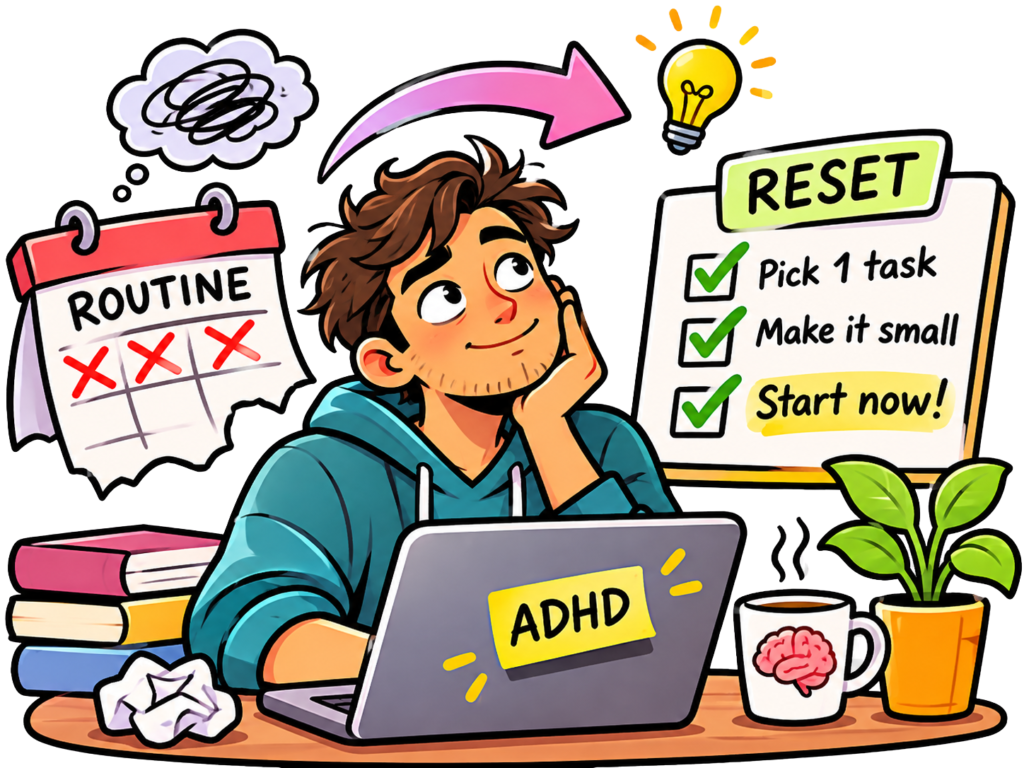
Losing your routine can feel frustrating when you have ADHD. You may start the week with a clear plan, follow it for a few days, and then suddenly fall behind.
Maybe you miss one workout, forget your planner, leave a few tasks unfinished, or spend a day feeling overwhelmed. Before you know it, your entire routine feels broken.
But here is something important: you do not need to restart your life every time your routine falls apart.
You need a simple way to begin again.
In this guide, you will learn practical ways to recover your momentum without trying to fix everything at once.
An ADHD routine reset does not mean starting over. It means choosing one small action that helps you rebuild momentum without trying to fix everything at once.
Why Is an ADHD Routine Reset So Difficult?
An ADHD routine reset can feel difficult when your energy, attention, or schedule changes.
A routine can help you reduce daily decisions. But maintaining it may become difficult when your energy, attention, or schedule changes.
Here are five common reasons getting back on track can feel difficult.
1. You Feel Like You Have Already Failed
You planned to follow your routine every day. Then you missed a few days.
You might think, “I have already messed everything up. I will start again next Monday.”
This way of thinking can turn one difficult day into a much longer break.
What helps: Treat a missed day as an interruption, not a failure. You can continue with one small action today instead of waiting for the perfect time to restart.
2. Your Old Routine Feels Too Big
When you try to restart, you may want to catch up on everything at once.
You might plan to clean your room, finish your work, organize your schedule, exercise, and prepare for the next day.
That is a lot to handle when you are already overwhelmed.
What helps: Reduce your routine to its smallest useful version.
Instead of cleaning the entire room, put away five items. Instead of planning your whole week, choose one important task for today.
Small actions help you rebuild momentum without creating another overwhelming plan.
3. You Do Not Know Where to Start
After a break, your tasks may have piled up. You might have unfinished work, unread messages, and several responsibilities competing for your attention.
Choosing what to do first can feel like another difficult task.
What helps: Choose one task and define the next physical action.
Do not write “catch up on work.”
Write “open the document and read the first paragraph.”
A clear action gives you somewhere to begin.
4. You Keep Trying to Rebuild the Perfect System
You may think you need a new planner, a better schedule, or a completely different productivity method.
You spend time organizing your system but still struggle to use it consistently.
What helps: Return to a system you already understand. Remove unnecessary steps instead of adding more.
Your system should help you take action, not become another responsibility.
5. You Forget How to Continue After an Interruption
Sometimes the hardest part is not starting. It is returning after you have been distracted, interrupted, or exhausted.
You may return to your desk and struggle to remember what you were doing or what comes next.
What helps: Before stopping, write down three things:
- What I was doing.
- Where I stopped.
- What I will do next.
When you return, you can use that note instead of figuring everything out again.
A Simple 10-Minute Reset for ADHD
When your routine feels completely off track, try this short reset.
Minute 1–2: Stop and Check In
Ask yourself what is making today difficult. Is the task unclear? Are you tired? Are there too many things competing for your attention?
You do not need to solve every problem right now. Just identify the biggest obstacle.
Minute 3–4: Choose One Priority
Pick one task that would make today a little easier.
Avoid choosing five priorities. Choose one.
Minute 5–6: Make the Task Smaller
Turn the task into an action you can complete or begin immediately.
For example:
- Instead of “organize my finances,” open your banking app.
- Instead of “finish the project,” open the project file.
- Instead of “clean the kitchen,” put the dishes in the sink.
Minute 7–8: Remove One Barrier
Prepare what you need, close an unnecessary tab, silence one notification, or move your phone away.
Make the first action easier to begin.
Minute 9–10: Start Without Catching Up
Work on the first action for a few minutes.
You do not need to make up for every missed day. Your goal is simply to create a new starting point.
If ten minutes feels like too much, start with two.
How to Make Your Routine Easier to Return To
A useful routine should not depend on having a perfect day.
Try these three principles:
Make it flexible. Create a smaller version for difficult days so you can maintain some momentum without demanding too much from yourself.
Make the next step visible. Keep a short note or checklist showing exactly what to do next.
Plan for interruptions. Expect that some days will not go as planned. Decide in advance how you will restart after a missed day or an unexpected problem.
Remember, consistency does not mean doing everything perfectly. It means having a realistic way to return when things get difficult.
What If You Keep Getting Stuck?
If you regularly struggle to begin tasks, manage daily responsibilities, or return to routines, you may need more support than a simple checklist.
Sleep problems, stress, mood difficulties, and other factors can also affect attention and energy. If these difficulties significantly affect your daily life, consider discussing them with a qualified healthcare professional.
Practical tools can support your daily routines, but they are not a replacement for professional care when you need it.
Ready to Make Everyday Tasks Easier?
You do not need another complicated productivity system. You need practical tools that make your next step clearer and help you keep moving when life gets messy.
The Softreturn Shop offers ADHD-focused digital resources designed to help you approach everyday challenges with simple, practical systems.
Explore the collection to find tools that fit your needs, whether you want help getting started, managing overwhelm, or building a more realistic routine.
Start with the support that makes sense for you. You do not have to change everything today.
Softreturn provides educational resources and practical tools. These resources are not a substitute for diagnosis, treatment, or advice from a qualified healthcare professional.
For more information about ADHD, visit the National Institute of Mental Health (NIMH).