
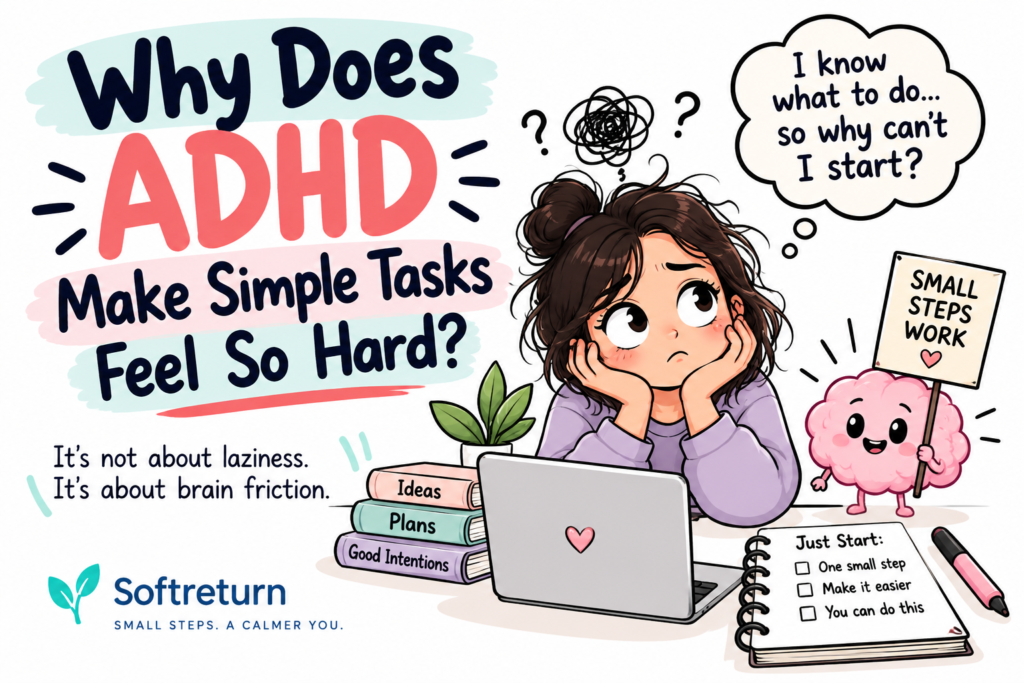
ADHD simple tasks can feel much harder than they look.
Just one.
You know exactly what it is. You know it won’t take that long. You even know you’ll probably feel better once it’s finished.
So you tell yourself:
“I’ll do it right now.”
You open your laptop… and somehow, 20 minutes later, you’re doing everything except the task.
You check your phone.
You open another tab.
You remember something else you need to do.
Maybe you get some coffee. Maybe you start organizing your desk. Maybe you suddenly find ten other things that feel easier to do.
Anything… except the one thing you actually planned to do.
And then you look at the clock and think:
“Where did all that time go?”
The hardest part is that you know you should be doing the task.
You may even be thinking about it all day.
You want to get it done.
You know it’s important.
You know you’ll feel better afterward.
But somehow, knowing isn’t enough to make your brain start.
And that’s where ADHD can become so frustrating.
Because from the outside, it can look like procrastination.
But from the inside, it can feel more like being stuck between wanting to start and being unable to start.
And this is where the problem gets bigger.
Because difficulty starting is often just the beginning.
You may finally start the task… and then lose focus.
You may have a productive morning… and completely lose momentum after one interruption.
You may get distracted, stop for a while, and then struggle to figure out how to start again.
So what looks like one ADHD problem can actually show up as several different struggles:
Starting. Focusing. Staying on track. Getting back to the task.
And when you keep fighting all of them with willpower alone, everyday tasks can become exhausting.
The good news is that you don’t have to solve all of these problems with willpower.
What if, instead of forcing yourself to “try harder,” you had simple tools for the moments when your brain gets stuck?
A way to figure out why you’re stuck.
A way to make starting easier.
A way to protect your focus.
And a way to get back to the task when you lose momentum.
That’s the idea behind the Softreturn ADHD Toolkit™.
The Toolkit is built around five simple steps:
Diagnose. Switch. Cue. Protect. Return.
Instead of trying to fix everything at once, you can focus on the part that’s actually getting in your way.
Maybe you need to understand why you can’t start.
Maybe you need a simpler way to get moving.
Maybe distractions keep breaking your focus.
Or maybe the hardest part is coming back after you’ve stopped.
The Softreturn ADHD Toolkit™ gives you a practical tool for each of these moments.
Why ADHD Simple Tasks Feel So Difficult
Simple tasks are not always simple for an ADHD brain.
The problem is often not that you don’t know what to do. It’s that your brain has to overcome several small barriers before you can actually begin.
A task can feel harder when it is boring, unclear, too big, emotionally uncomfortable, or when there are too many distractions around you.
That’s why telling yourself to “just do it” often doesn’t help.
You don’t always need more discipline.
Sometimes, you need to reduce the friction between knowing what to do and actually starting.
What makes a simple task feel difficult?
It usually isn’t just one thing.
Sometimes the task feels too big, even when it would only take 10 minutes.
Sometimes you don’t know where to begin.
Sometimes you are interested in the goal, but the first step feels painfully hard.
And sometimes, you start… but one small distraction is enough to pull you away.
These moments can look different, but they often create the same result:
You know what you need to do, but you can’t seem to get yourself moving.
The hidden friction behind “simple” tasks
ADHD can make the starting point feel much harder than the task itself.
You may understand every step. You may even have enough time and know exactly why the task matters.
But your brain still has to cross that gap between intention and action.
Task initiation is also recognized as an executive function skill.
That gap can be affected by things like boredom, uncertainty, low motivation, distractions, or the feeling that the task is too demanding.
The important part is this: the difficulty is real, even when the task looks simple from the outside.
What Can Actually Help?
Instead of asking yourself to “try harder,” start by asking a different question:
What is making this task hard to start?
Maybe the task is too vague.
Maybe the first step is too big.
Maybe you’re bored.
Maybe you’re already mentally tired.
Maybe your environment is full of distractions.
Once you identify the friction, you can change the way you approach the task.
Make the first step smaller.
Make the starting point clearer.
Remove one distraction.
Create a simple cue to begin.
You don’t need to fix everything at once.
You just need to make the next step easier to take.
A Simple Way to Start
When a task feels difficult, don’t focus on finishing it.
Focus on making the beginning easier.
Instead of saying:
“I need to clean the whole room.”
Try:
“I’ll put away five things.”
Instead of:
“I need to finish this project.”
Try:
“I’ll open the document and write one sentence.”
The goal is not to trick yourself into doing everything.
The goal is to reduce the friction between thinking about the task and actually starting it.
Once you start, continuing often becomes easier.
The Goal Isn’t to Force Yourself
ADHD can make simple tasks feel harder than they look.
The answer isn’t always more discipline, more pressure, or telling yourself to “just do it.”
Sometimes, the better approach is to understand what is making the task difficult and reduce that friction.
Make the first step smaller.
Make the task clearer.
Protect your attention.
And give yourself an easier way back when you get distracted.
You don’t have to make the whole task easy.
You just need to make the next step easier.
A Practical System for ADHD
If you often know what you need to do but still struggle to start, focus, or get back on track, having practical tools can make the process easier.
That’s why we created the Softreturn ADHD Toolkit™ — a practical system designed around five steps:
Diagnose → Switch → Cue → Protect → Return
It helps you identify what’s getting in the way, make starting easier, protect your focus, and return to the task when you lose momentum.
If you want practical tools for these everyday ADHD struggles, you can explore the Softreturn ADHD Toolkit™ here.