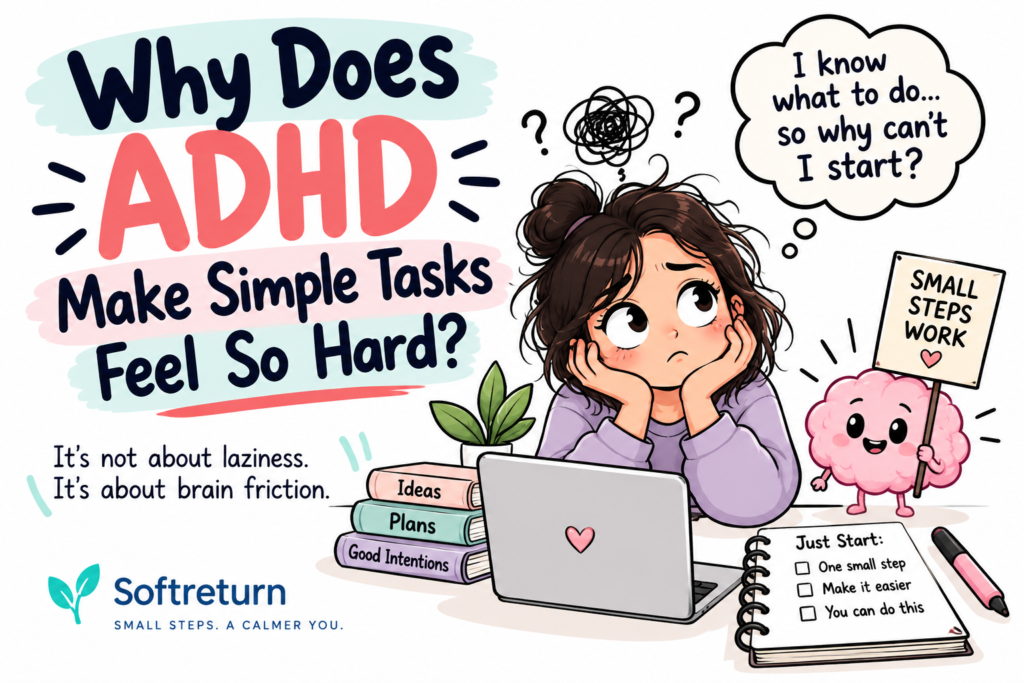
If you have ADHD, you already know the feeling. The task is sitting right there. You know exactly what needs to be done. And yet — you cannot start. You open the document, stare at it for thirty seconds, and suddenly find yourself reorganizing your entire desk or watching a video about something completely unrelated.
This is not laziness. This is not a character flaw. This is ADHD procrastination, and it works differently from regular procrastination in ways that most productivity advice completely ignores.
Why ADHD Procrastination Is Not What People Think
Most people assume procrastination is about avoiding hard work. But for ADHD brains, procrastination is usually about one thing: dopamine. The ADHD brain is not wired to get motivated by future rewards the way neurotypical brains do. It needs interest, urgency, challenge, or passion — right now — to activate. According to CHADD, one of the leading ADHD support organizations, this connection between dopamine and motivation is a well-documented feature of ADHD.
This means that even tasks you genuinely care about can feel impossible to start if they do not trigger that dopamine response in the moment. You are not avoiding the task because you are lazy. You are avoiding it because your brain is literally not producing the chemical signal it needs to begin.
This is also why ADHD procrastination often comes with something that regular procrastination does not: crushing guilt. You know you should start. You want to start. And the fact that you cannot makes you feel broken, stupid, or hopeless — which makes starting even harder.
The Guilt-Procrastination Loop
Here is what usually happens. You avoid a task. You feel guilty about avoiding it. The guilt makes the task feel heavier and more loaded with negative emotion. Now it is not just a task — it is proof that something is wrong with you. So your brain avoids it even more. The cycle repeats, and the task grows into something that feels impossible to touch.
This is not a motivation problem. It is a nervous system problem. And it requires a completely different approach than what most productivity gurus suggest.
What Does Not Work for ADHD Procrastination
Before we talk about what helps, it is worth naming what does not work — because most people with ADHD have already tried these things and blamed themselves when they failed.
Rigid schedules do not work long-term for most ADHD brains. Time-blocking sounds great in theory, but when your brain refuses to cooperate at 9am on a Tuesday, a beautiful color-coded calendar just becomes another source of shame.
Motivational quotes do not work. Willpower does not work. Telling yourself you will feel better once you start sometimes works — but getting to that point of starting is the entire problem.
What Actually Helps
The key is working with your brain’s dopamine system instead of fighting it.
First, make starting as small as possible. Not “work on the project for an hour.” Just open the file. Just write one sentence. Just set a five-minute timer. The goal is not productivity — the goal is activation. Once your brain gets a tiny taste of momentum, it becomes much easier to continue.
Second, remove the guilt from the equation entirely. Guilt is not motivating for ADHD brains — it is paralyzing. Replacing self-judgment with curiosity (“interesting, I’m avoiding this — I wonder why”) can actually help you engage with the task more quickly.
Third, use visual progress. ADHD brains respond powerfully to seeing evidence of movement. Checkboxes, trackers, and progress bars are not just aesthetic — they provide the small dopamine hits your brain needs to keep going.
Fourth, plan for low-energy days. Not every day will be a high-output day, and pretending otherwise leads to burnout and shame spirals. Having a realistic, flexible plan for days when your energy is low is not giving up — it is being smart about how your brain works.
A Gentle System That Works
If you are tired of productivity tools that were clearly not designed for your brain, you are not alone. Most of them were built by and for neurotypical people, and they completely miss what ADHD brains actually need.
That is exactly why we created the Anti-Procrastination ADHD Pack — a collection of five gentle, dopamine-friendly tools designed specifically to help ADHD brains break through task paralysis, celebrate small wins, and build real consistency without the guilt.
It is not another rigid system. It is a soft, flexible toolkit that meets you exactly where you are — even on the days when starting feels completely impossible.